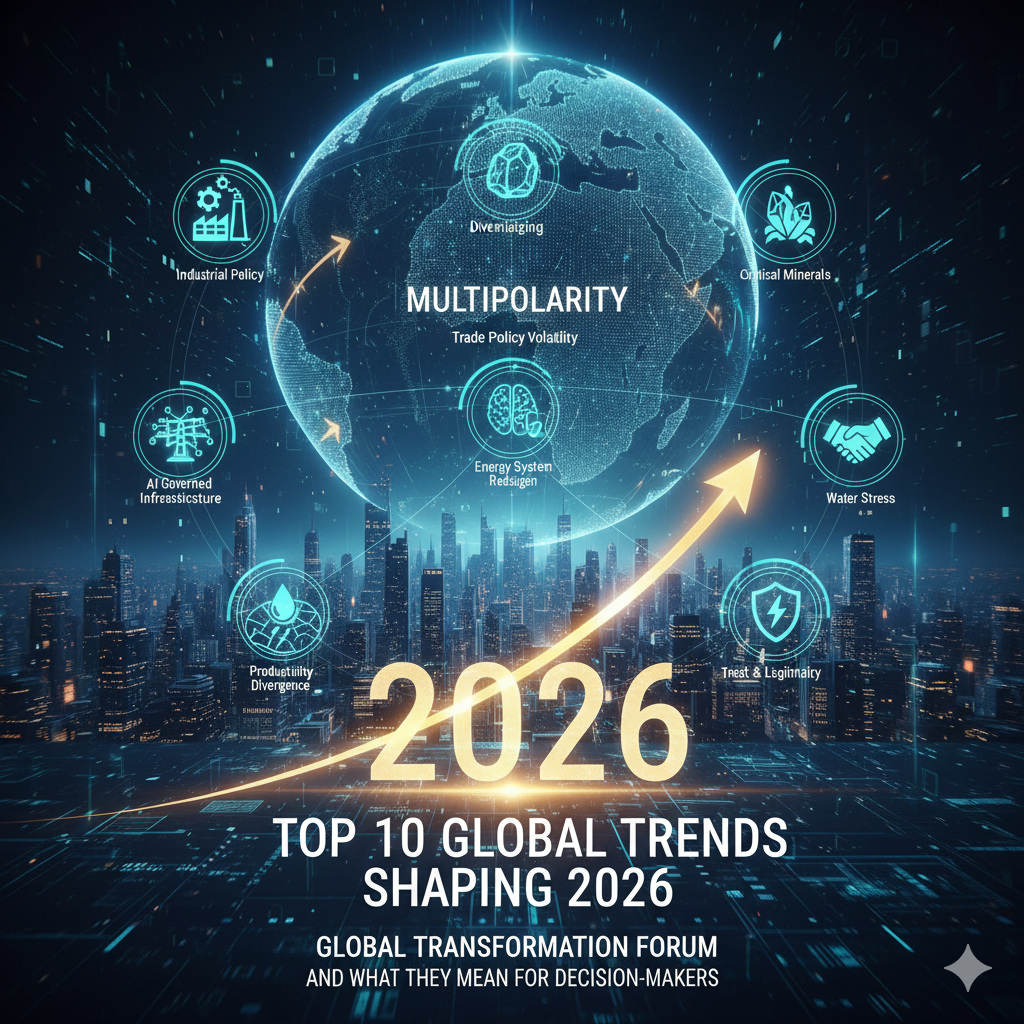
Top 10 Global Trends Shaping 2026 (and What They Mean for Decision-Makers)
The trends below are derived by triangulating across major, high-credibility outlooks (IMF, OECD, IEA, EU, UN, WTO; plus leading geopolitical/strategy institutions). While no forecast is perfect, there is unusually strong cross-source convergence on these themes for 2026.
Table of Contents
-
Executive Summary
-
How to Read These Trends
-
The 10 Global Trends Shaping 2026
-
Trend 1: Multipolarity becomes operational reality
-
Trend 2: Industrial policy and state interventionism scale up
-
Trend 3: Trade policy volatility + “re-wiring” of supply chains
-
Trend 4: The race for critical minerals intensifies
-
Trend 5: AI shifts from experimentation to governed infrastructure
-
Trend 6: The energy system is redesigned around power demand (and AI)
-
Trend 7: Water stress becomes a strategic and geopolitical variable
-
Trend 8: Productivity divergence widens (AI haves vs. have-nots)
-
Trend 9: Trust, information integrity, and social legitimacy become core strategy
-
Trend 10: The resilience imperative becomes board-level doctrine
-
-
Policy Recommendations (Government + Business)
-
Implications for GTF Members, Clients, and Partners
-
Conclusion
1) Executive Summary
2026 will be remembered as the year global transformation stops being a program and becomes the operating environment. The world is moving from episodic disruption to persistent reconfiguration—geopolitically, technologically, economically, and institutionally.
The headline: decision-makers must treat geopolitics, AI governance, energy security, and supply chain resilience as interdependent systems—not separate workstreams. Outlooks from BCG and EY converge on increasing multipolarity, new rules and norms for business, and the “geopolitics of scarcity” (notably critical minerals and water). Macro institutions underscore slower global growth with elevated trade-policy uncertainty through 2026, reinforcing the premium on resilience and adaptability.
2) How to Read These Trends
A useful way to interpret 2026 is as a constraint-and-capability year:
-
Constraints: fragmented rules, higher uncertainty, resource bottlenecks, water stress, and political volatility.
-
Capabilities: AI-augmented productivity, new energy investment patterns, and faster coordination mechanisms for digital governance.
The strategic question is not “What trend is biggest?” but “Which combinations of trends compound risk or unlock advantage in my sector?”
3) The 10 Global Trends Shaping 2026
Trend 1: Multipolarity becomes operational reality
2026 is not merely “more complex geopolitics.” It is a shift toward multipolar competition where more actors shape the environment for business—creating a patchwork of alliances, standards, and constraints.
What it means for decision-makers
-
Strategy must be portfolio-based by region (market access, compliance, partnerships).
-
Government relations becomes a core strategic capability, not a support function.
-
“Neutrality” is harder: regulatory expectations increasingly reflect bloc priorities.
Trend 2: Industrial policy and state interventionism scale up
Governments are using subsidies, restrictive trade policies, investment mandates, and other tools to pursue economic security—a central theme in major 2026 geopolitical outlooks.
What it means
-
Corporate strategy must assume policy-driven market structure (not purely competitive dynamics).
-
Location decisions (manufacturing, R&D, data) should optimize for incentives + compliance + resilience, not labor cost alone.
Trend 3: Trade policy volatility + “re-wiring” of supply chains
Macro forecasts explicitly assume elevated trade-policy uncertainty through 2026. Meanwhile, trade networks are diversifying rather than consolidating—creating resilience but also complexity.
What it means
-
Invest in multi-region supplier portfolios and “compliance-by-design.”
-
Treat customs, sanctions exposure, and rules-of-origin as strategic variables.
Trend 4: The race for critical minerals intensifies
Critical minerals are now a frontline geopolitical and industrial issue—with concentrated supply chains and rising demand expectations.
What it means
-
For energy, tech, mobility, and defense sectors: minerals strategy becomes as important as capital strategy.
-
Expect more export controls, local content rules, and “secure supply” partnerships.
Trend 5: AI shifts from experimentation to governed infrastructure
2026 is a governance watershed: the EU AI Act becomes fully applicable in August 2026 (with staged obligations and exceptions), reinforcing AI as regulated infrastructure rather than optional tooling. In parallel, the UN’s Global Digital Compact is positioning digital cooperation and AI governance as a shared global agenda.
What it means
-
Boards should demand an AI governance stack: model risk management, transparency controls, human oversight, and audit readiness.
-
Competitive advantage shifts from “who has models” to who operationalizes trust (lawful, safe, explainable, secure).
Trend 6: The energy system is redesigned around power demand (and AI)
2026 energy outlooks highlight the collision of electricity affordability, data-center load, and policy shifts, with AI acting as both demand driver and system optimizer. Clean-energy investment remains structurally large, but politics and affordability shape deployment paths.
What it means
-
Firms must treat electricity as a strategic input (site selection, contracts, grid access).
-
Energy transition strategy becomes more “systems engineering” (grids, storage, demand response), less “procurement checkbox.” IEA+1
Trend 7: Water stress becomes a strategic and geopolitical variable
Several 2026 risk outlooks elevate water scarcity and governance as a conflict and instability multiplier.
What it means
-
Water risk belongs in enterprise risk, supply planning, and infrastructure decisions—especially in food, energy, mining, and manufacturing.
-
Expect more scrutiny on water-intensive operations and upstream suppliers.
Trend 8: Productivity divergence widens (AI haves vs. have-nots)
High-quality economic analysis points to AI as a potential productivity engine—but uneven diffusion risks widening gaps across firms and countries. Recent economist surveys anticipate persistent productivity advantage where AI capability, investment, and enabling conditions are strongest.
What it means
-
Winning organizations invest in complementary assets: data readiness, process redesign, training, and change management—not just models. OECD+1
-
Governments face a distribution challenge: boosting diffusion to SMEs and lagging regions to prevent structural inequality. OECD+1
Trend 9: Trust, information integrity, and social legitimacy become core strategy
Risk outlooks for 2026 explicitly warn of AI-enabled manipulation and societal impacts, putting information ecosystems and legitimacy at the center of stability and governance. Leadership outlooks similarly emphasize rising human expectations and the reshaping of leadership in uncertainty.
What it means
-
“Reputation” becomes measurable: invest in integrity-by-design (content provenance, governance, clear accountability).
-
Leaders must shift from messaging to verifiable outcomes and transparent decision logic.
Trend 10: The resilience imperative becomes board-level doctrine
Geostrategy outlooks emphasize persistent volatility and the need for proactive resilience actions (supply chains, capital markets, governance). Macro projections of slower growth and continued uncertainty reinforce that resilience is no longer a “downside hedge”—it is a growth enabler.
What it means
-
Treat resilience as a capability portfolio: operational, cyber, energy, talent, and regulatory.
-
Redesign governance so risk intelligence reaches strategic decision loops fast enough to matter.
4) Policy Recommendations (Government + Business)
A. Recommendations for Governments & Multilaterals
-
Build “economic security” without strangling competition
-
Use targeted industrial policy with transparent metrics and sunset clauses to reduce waste and capture.
-
-
Accelerate critical-minerals diversification responsibly
-
Co-invest in processing capacity, standards, and recycling; deepen trusted partnerships to reduce concentrated dependencies.
-
-
Treat AI governance as a public infrastructure project
-
Align domestic rules with emerging regimes (e.g., EU AI Act obligations) and global cooperation frameworks (UN Global Digital Compact) to reduce fragmentation costs.
-
-
Modernize water governance for stability
-
Invest in monitoring, pricing reforms where feasible, and cross-border basin cooperation to prevent water stress becoming a security crisis.
-
-
Enable productivity diffusion
-
Fund workforce transition, SME adoption support, and digital public goods to avoid widening productivity and income gaps.
-
B. Recommendations for CEOs, Boards, and Institutional Investors
-
Run strategy as a “3-horizon portfolio” under multipolarity
-
Horizon 1: compliance and continuity; Horizon 2: optionality; Horizon 3: bets on new ecosystems.
-
-
Implement an AI governance stack before regulators force it
-
Model inventory, risk classification, documentation, monitoring, human oversight, and audit readiness.
-
-
Lock in energy advantage
-
Treat electricity price and availability as strategic; pursue power purchase agreements, grid partnerships, and flexibility investments. Axios+1
-
-
De-risk critical inputs and water exposure
-
Map upstream dependencies, build redundancy, and establish supplier standards aligned with resource constraints. Council on Foreign Relations+1
-
-
Operationalize trust
-
Integrity, transparency, and verifiable impact metrics become part of brand, retention, and license-to-operate.
-
5) Implications for GTF Members, Clients, and Partners
For GTF’s ecosystem, 2026 is a prime year to convene cross-sector coalitions around the intersections that matter most:
-
AI governance + productivity diffusion (so transformation is inclusive, not extractive) United Nations+1
-
Energy system redesign + competitiveness (especially electricity affordability and grid readiness) Axios+1
-
Critical minerals + trade resilience (moving from “concern” to investable coordination) Council on Foreign Relations+1
This is where partnerships form: when convening shifts from thought leadership to shared execution frameworks.
6) Conclusion
The defining feature of 2026 is not any single trend—it is the coupling of trends: multipolarity reshaping trade rules, AI governance hardening, energy demand surging, and scarcity (minerals, water) becoming geopolitical. TIME+3BCG Global+3EY+3
Decision-makers who win in 2026 will do three things consistently:
-
Design for fragmentation (without surrendering to paralysis)
-
Govern transformative technology early (AI as infrastructure)
-
Invest in resilience as growth capacity (energy, supply, talent, trust)
That is the new playbook for global transformation—and 2026 is when it becomes non-negotiable.
Check out the GTF Research
Check out events
Connect with us on facebook
connect with us on linkedIn
Check out the American Transformation forum